
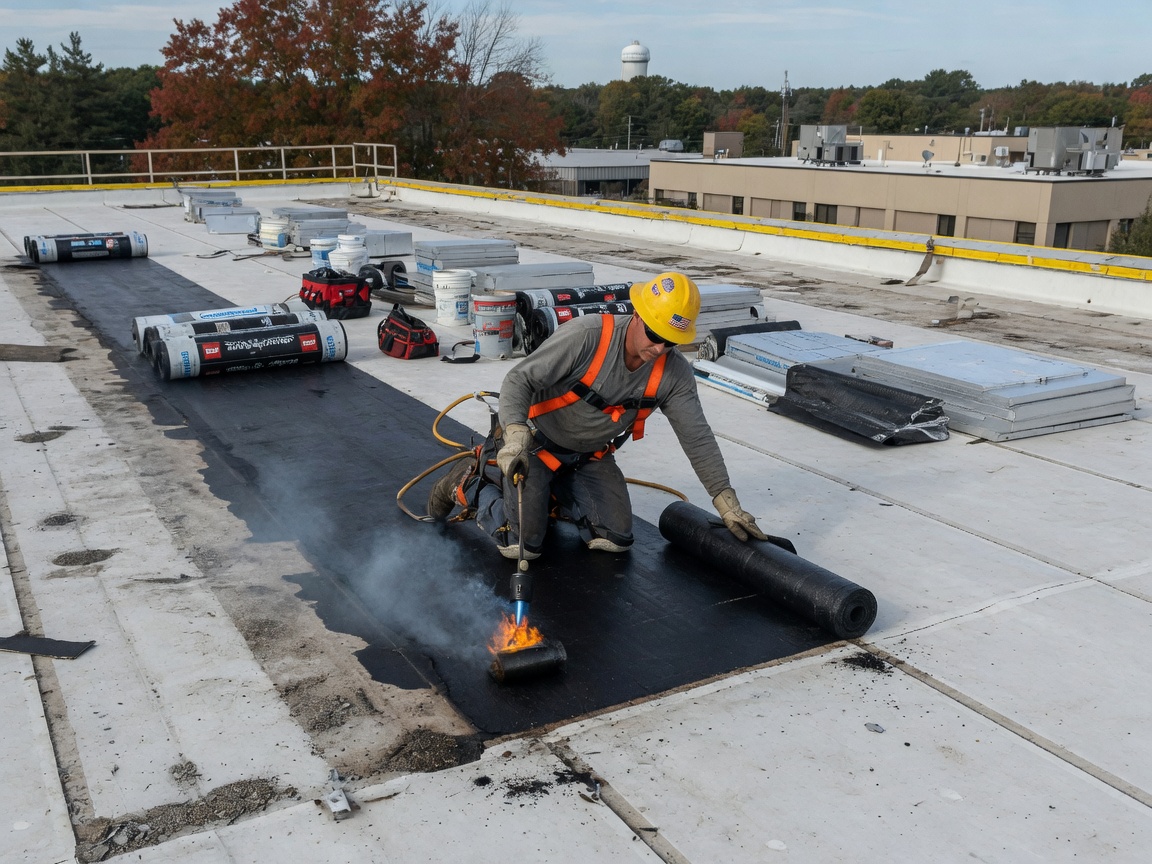
Commercial roofing is a different trade from residential, not a bigger version of it. A low-slope membrane roof does not shed water, it holds it and drains it, which means every detail that penetrates the membrane is a potential failure and ponding is a design problem rather than an inconvenience. The office parks and industrial units along the 495 corridor, the converted mill space in Maynard and Hudson, and the mixed commercial stock around Devens are almost all EPDM, TPO or older built-up systems, and each fails in its own characteristic way.
EPDM — the black rubber membrane on most buildings of this vintage — fails at the seams and at the flashing details rather than in the field. Older EPDM was seamed with tape adhesives that dry out and lift, particularly on the south and west elevations where UV exposure is highest, and at every curb, drain and pipe penetration. The good news is that EPDM is highly repairable and a sound field membrane with failed seams is a restoration candidate rather than a replacement. TPO, the white single-ply now more common on newer buildings, is more reflective and generally better on energy cost, but its weak point is heat-welded seams that were welded badly at installation and which show up as failures within a few years.
Ponding is the issue we are called about most on older flat roofs. Standing water that has not drained within 48 hours after rainfall is outside what the code contemplates and it will find every marginal seam eventually, as well as adding load and accelerating membrane degradation. The causes are usually blocked or undersized drains, deflection in the deck between supports, or insulation that was laid flat where it should have been tapered. Which one it is determines whether you are looking at a drain clean, a tapered insulation package, or a structural conversation.
The practical constraint on commercial work is that your building has to keep operating. We phase work by section so no area is open longer than a day, schedule noisy and disruptive phases around your hours where that is possible, and keep tenant and staff access routes clear of dumpsters and material. Commercial roofing in Massachusetts requires a Construction Supervisor License and falls under the base volume of 780 CMR rather than the residential code — different requirements, different inspection process, and in Boxborough a commercial permit fee of $14 per $1,000 of estimated cost with a $100 minimum.
Technician insight
The decision that saves commercial clients the most money is restoration versus replacement, and it usually gets made backwards. A twenty-year-old EPDM roof with dried-out seams and failed curb flashing looks finished, but if the field membrane still has integrity and the insulation underneath is dry, a restoration system will buy ten to fifteen years for well under half the cost of tear-off and replacement — with no disruption to the tenants. The thing that decides it is whether the insulation is wet, and that is worth a moisture survey before anyone quotes anything.
Not a new roof — two blocked drains and a flat spot
A small office building near the 495 interchange had ponding across a third of the roof and two active leaks over tenant space. The assumption was full replacement. The field membrane was sound and the insulation tested dry; the ponding came from two blocked internal drains and a flat area that had never been tapered. Clearing and resizing the drains, adding a tapered insulation section, and rebuilding the curb flashing on the rooftop units solved both leaks and the ponding, phased over four days with no tenant disruption — for a fraction of a replacement.
Commercial Roofing Services We Offer
✓EPDM Rubber Roofing
Seam, flashing and penetration repair on EPDM rubber roofs, plus full membrane replacement where the field itself has degraded rather than just the details.
✓TPO Single-Ply Roofing
Repair of failed heat-welded seams, curb and penetration detailing, and new TPO installation on buildings where reflectivity and cooling load matter.
✓Ponding Water Correction
Assessment and correction of standing water — drain clearing and resizing, tapered insulation and additional outlets, depending on what is actually causing it.
✓Roof Restoration and Coating
Coating and restoration systems that extend the life of a sound field membrane with failed details, at a fraction of replacement cost and without tear-off disruption.
✓Penetration and Curb Flashing
Curb, drain, pipe, HVAC and skylight detailing — the points where nearly all low-slope roofs actually fail, rather than in the open field.
✓Commercial Maintenance Programmes
Scheduled inspection and maintenance programmes with documented reports, which is what most commercial roof warranties require to stay valid.
Commercial Roofing Cost in Boxborough, MA
| Service | Typical Range | What Affects It |
|---|---|---|
| EPDM seam and detail repair | $400–$1,500 | Per repair area, existing sound membrane |
| EPDM replacement, fully adhered | $7–$13/sq ft | Per square foot, including tear-off |
| TPO replacement | $8–$14/sq ft | Per square foot, mechanically attached |
| Restoration coating system | $3–$7/sq ft | Per square foot, over sound field membrane |
| Tapered insulation for ponding | $4–$9/sq ft | Per square foot of affected area |
| Boxborough commercial permit | At cost | Town fee: $14 per $1,000 of cost, $100 minimum |
Ranges are typical for Boxborough, MA and confirmed with an exact written quote before any work starts.
How it works
- 1
Survey the system and the drainage
We identify the existing system and its age, survey the field, seams, terminations and every penetration, and check drainage performance and any ponding areas with the building's drawings where you have them.
- 2
Establish repair, restore or replace
Where the field membrane is sound, restoration or targeted repair is almost always the better commercial decision. We say which category your roof is in and price both options rather than defaulting to replacement.
- 3
Written report and priced options
You get a report with photographs, a condition assessment by area, drainage findings and options priced separately — something you can take to a facilities committee or a landlord rather than a single number.
- 4
Phase the work around the business
Work is phased by section so no area is open overnight, scheduled around your operating hours where possible, with access routes, parking and tenant entrances kept clear and any roof-mounted equipment coordinated with your contractors.
- 5
Documentation and maintenance schedule
Completion documentation, warranty paperwork and a maintenance schedule — commercial warranties commonly require documented periodic inspection, and losing that record is how a valid warranty becomes an invalid one.
Pricing
Low-slope work is priced per square foot and varies widely by system, access and the state of the insulation underneath. Repairs and restoration coatings are a fraction of replacement cost and are frequently the right answer on a roof whose field membrane is still sound. Replacement costs depend heavily on whether the existing insulation can stay or has to come out. We survey before quoting and show you the options side by side.