
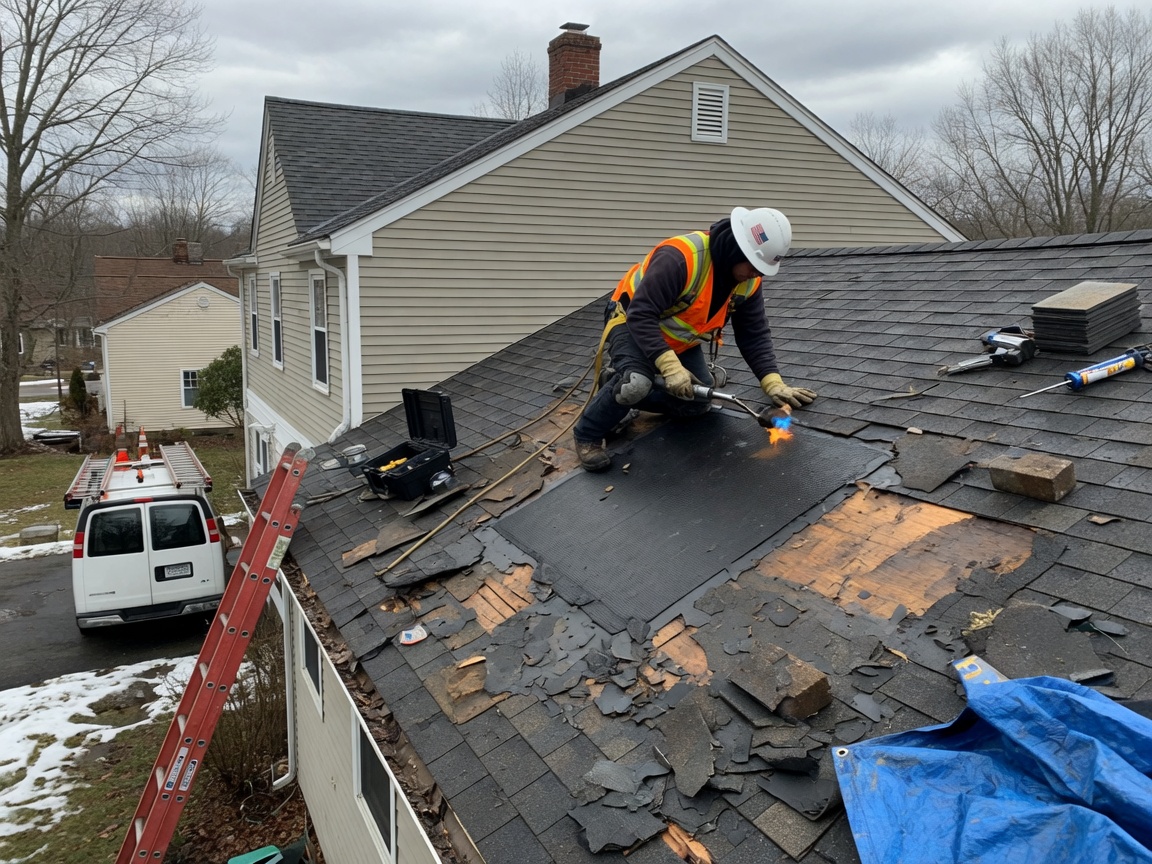
An emergency roof call has two halves, and the first one is yours. Before anyone can get to your house there are things that materially change how much damage you end up with, and nobody tells homeowners what they are. Move what is under the leak. Put a bucket down, and put a towel in the bucket so it stops drumming. If the ceiling is bulging with trapped water, push a small hole through the low point of the bulge with a screwdriver and let it drain into the bucket — that sounds wrong, and it is the single best thing you can do, because a controlled drain hole saves a ceiling that a collapse destroys. Kill the power to any circuit near the water. Then call.
The second half is ours, and the honest version is this: we answer and respond Monday to Friday 8am to 6pm and Saturday 9am to 2pm, and during those hours an active leak goes to the front of the queue ahead of scheduled work. We are an owner-operated business, not a national dispatch service, so we will not claim a 24-hour hotline we do not staff. What we will do is give you a realistic arrival window and tell you honestly if you need someone sooner than we can manage.
The first visit is about stopping water, not finishing a repair. A proper emergency tarp is mechanically fastened along a batten above the damage and run over the ridge where possible, not weighted down with bricks at the corners — an unfastened tarp in a New England wind is gone by morning and has usually taken a few more shingles with it. Where the damage is small and the weather allows, we will do a permanent repair on the spot instead. Either way, we photograph everything before we cover it, because once a tarp goes on, the evidence an insurance adjuster needs is underneath it.
Then we look inside. Water that has come through a roof is in the insulation and often in the wall cavity, and the roof repair is only half the problem. Wet cellulose or fibreglass stays wet for weeks, stops insulating permanently, and grows mould in a heated house. We will tell you what is saturated and needs pulling, and where the drying needs to happen before anything gets closed back up. A roofer who patches the hole and drives off has solved the smaller half of your problem.
Technician insight
The thing that costs people money in an emergency is not the roof — it is the ceiling they were too polite to put a hole in. A bulging plaster or drywall ceiling holding water will let go, and when it does it takes the whole section, the light fitting and everything below it. A deliberate quarter-inch hole at the lowest point of the bulge drains it into a bucket and usually saves the ceiling entirely. I have said this on the phone to homeowners in Boxborough more times than I can count, and the ones who do it keep their ceilings.
A Saturday thaw in Harvard
A February thaw in Harvard put water through a second-floor bedroom ceiling on a Saturday morning. On the phone we talked the homeowner through draining the bulge into a bucket and moving the bed. We got there that morning, found an ice dam that had backed water three feet up under the shingles, steamed the eave clear rather than chipping at it, photographed everything and dried the area in. The permanent repair — new ice-and-water shield along that eave and intake ventilation to stop it recurring — went in three weeks later on a dry day.
Emergency Roof Repair Services We Offer
✓Emergency Tarping and Dry-In
Mechanically fastened emergency tarping over the damaged area, battened and run over the ridge where the roof allows, so it survives the next wind rather than the next hour.
✓Same-Visit Leak Repair
Immediate permanent repair where the damage is contained and conditions allow — often cheaper and faster than tarping and returning.
✓Storm and Wind Damage Response
Response after wind events that have lifted, creased or removed shingles, including the hidden creasing on surrounding courses that fails a season later.
✓Ice Dam Emergency Response
Emergency work on ice dam leaks, including safe steam or mechanical removal rather than chipping at ice with tools that destroy the shingles underneath.
✓Fallen Limb and Impact Damage
Response to impact damage from fallen limbs, including assessment of the decking and framing underneath before anything is covered over.
✓Damage Documentation for Claims
Full photographic record of the damage before tarping, timed and described, in the form an adjuster can actually work from.
Emergency Roof Repair Cost in Boxborough, MA
| Service | Typical Range | What Affects It |
|---|---|---|
| Emergency tarp, single area | $400–$900 | Battened and fastened, standard access |
| Large or multi-slope tarping | $900–$2,000 | Steep pitch or extensive damage |
| Same-visit permanent repair | $350–$1,200 | Where damage is contained and weather allows |
| Emergency ice dam steam clearing | $500–$1,400 | To stop active water entry, per eave section |
| Damage documentation for insurance | Included | Photos and written scope, with any work |
Ranges are typical for Boxborough, MA and confirmed with an exact written quote before any work starts.
How it works
- 1
Call, then contain the water inside
Call (978) 797-1851 and describe where the water is entering and what the weather did. While you wait: contain the water, drain a bulging ceiling deliberately, move belongings, and cut power to affected circuits.
- 2
We prioritise and give you a real window
During business hours we prioritise active water entry over scheduled work. We will give you a realistic arrival window rather than an optimistic one, and if you need someone sooner than we can manage, we will say so.
- 3
Photograph before covering
Everything gets photographed before it is covered. Damaged area, surrounding courses, interior staining, wet insulation. This is the record your insurer will want and it disappears the moment a tarp goes down.
- 4
Tarp properly or repair permanently
A battened, fastened tarp if the damage is extensive or the weather is closing in; a permanent repair on the spot if the damage is contained and conditions allow. We tell you which we are doing and why.
- 5
Assess the interior, then plan the permanent fix
We check what is wet inside, tell you what needs to come out to dry, and give you a written scope and price for the permanent repair, scheduled as soon as conditions allow.
Pricing
An emergency visit that ends in a proper tarp typically runs in the mid-hundreds, depending on roof access, height and how much area needs covering. Where we can make a permanent repair on the same visit, you pay for the repair rather than for the tarp plus a return trip — which is usually cheaper, and is why we look at that option first. The permanent repair or replacement is quoted separately once the damage is fully visible.