
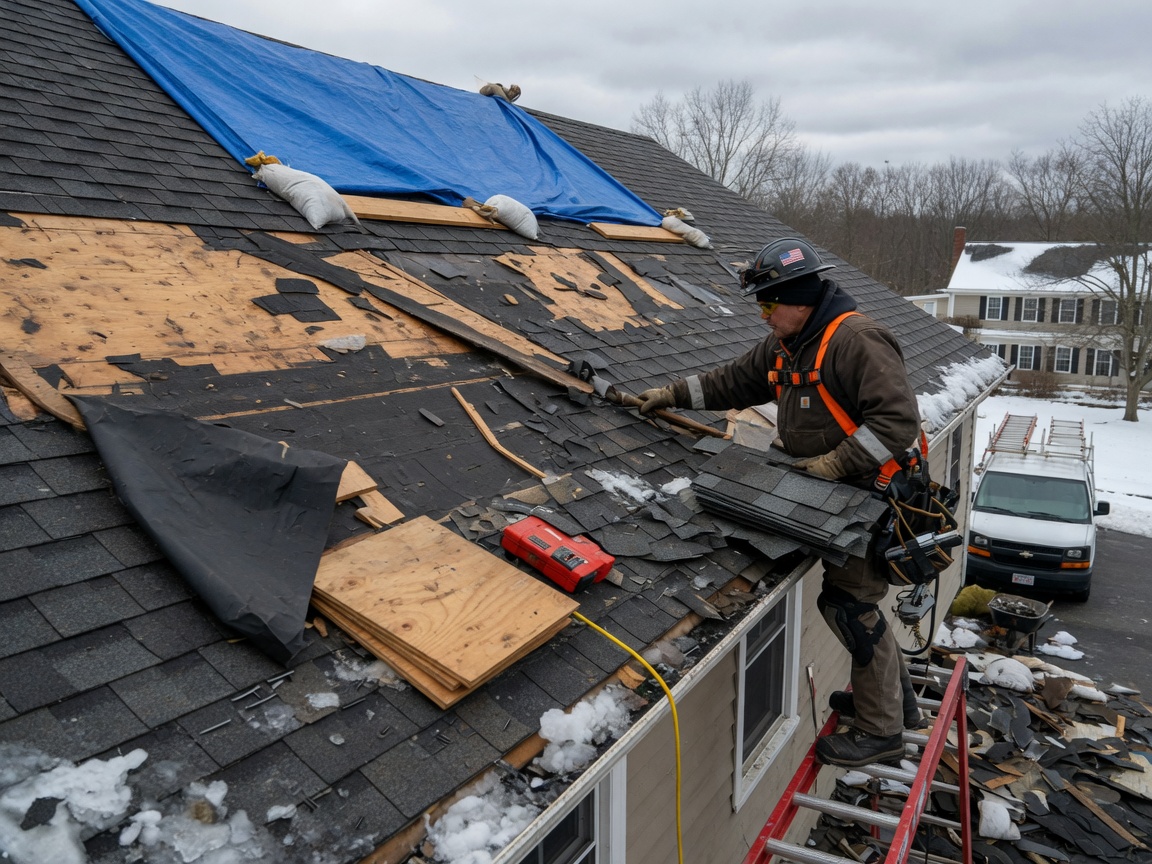
This region gets four distinct kinds of roof damage, and they need different responses. Nor'easter wind, which arrives from the northeast rather than the prevailing southwest and therefore attacks the slopes and the rake edges your roof is least prepared for. Ice dams, which cause damage without removing a single shingle. Heavy wet snow, which is a structural question rather than a roofing one. And summer microbursts and thunderstorm downbursts, which strip shingles in small, sharply defined patches and are routinely misdiagnosed as wear.
Wind damage is the most under-reported, because a wind-damaged roof usually looks fine. What happens is that shingles lift, the sealant strip breaks, and they drop back down looking undisturbed — but they are no longer bonded, and a horizontal crease has formed across the mat. That crease is the failure point. The roof will look normal for one season and start leaking in the next, by which time the storm date is long past and the insurance window has closed. After any significant wind event, the roof is worth looking at specifically for creasing and broken seals, not just for missing shingles.
Ice dams are the signature failure of this climate, and they are not really a roofing problem. Heat escaping into a cold attic melts the snow on the upper roof, the meltwater freezes at the cold overhang, and the resulting ice backs the next round of water up under the shingle courses. The permanent repair is air-sealing, insulation depth at the eaves and balanced ventilation. Anyone who proposes solving your ice dams with heat cables alone is treating the symptom and charging you annually for it.
Snow load is the one we get asked about during the big winters, and the honest answer is that a structurally sound roof in this area is designed for our snow and is very unlikely to fail. What fails is drift accumulation — on lower roofs below a taller wall, in valleys between two planes, and behind dormers, where snow piles two or three times deeper than on the open field. Those are the areas worth raking from the ground. If you are seeing new cracks in interior ceilings or doors that suddenly will not close during a heavy snow winter, that is a structural call and should be made straight away.
One thing worth doing before any of this happens: find out whether your policy settles roof claims at actual cash value or replacement cost. On an older roof the difference between the two is frequently thousands of dollars on an approved claim, and it is far better to know that in October than to discover it from an adjuster's letter in March.
Technician insight
The damage people miss is the wind crease. After a real blow, shingles lift, the seal strip tears and they fall back into place looking perfect — but there is a crease across the mat and no bond holding them down. The roof looks fine all summer and starts leaking the following winter, by which time the storm date is eighteen months gone and the claim window has shut. If a serious nor'easter goes through, have someone look at the roof that month, not when it leaks.
Three shingles in the garden, one slope unbonded
After a March nor'easter, a Bolton homeowner on an exposed hill saw three shingles in the garden and assumed that was the extent of it. On the roof, an entire section of the northeast-facing slope had broken its seal bonds — shingles sitting flat but lifting by hand, with creases across the mat. Because it was found and documented within the week, the damage was still plainly attributable to that storm. Left until it leaked the following winter, the same damage would have been indistinguishable from ordinary wear.
Storm & Winter Damage Roof Repair Services We Offer
✓Wind and Nor'easter Damage
Assessment and repair after nor'easters and high-wind events, including the broken seal bonds and horizontal creasing that leave no visible damage from the ground.
✓Ice Dam Damage and Prevention
Damaged eave underlayment and sheathing rebuilt with ice-and-water shield, plus the air-sealing and ventilation work that stops the dam forming again.
✓Snow and Ice Removal
Safe steam removal of ice dams and raking of drift-loaded areas — valleys, dormer backs and lower roofs below a taller wall.
✓Fallen Limb and Impact Repair
Repairs after limb strikes and impact damage, including assessment of the decking and framing underneath before anything is covered.
✓Microburst and Hail Damage
Localised shingle stripping from summer downbursts, which is sharply defined, commonly mistaken for wear, and frequently claimable.
✓Insurance Claim Documentation
Dated, photographed damage documentation written in terms an adjuster can work from, including the pre-existing condition of the surrounding roof.
Storm & Winter Damage Roof Repair Cost in Boxborough, MA
| Service | Typical Range | What Affects It |
|---|---|---|
| Wind damage repair, localised | $350–$900 | Lifted, creased or missing shingles |
| Scheduled ice dam steam removal | $500–$1,400 | Booked visit, not emergency — per eave section |
| Eave rebuild after ice damage | $900–$2,800 | Underlayment, ice-and-water shield, shingles |
| Air sealing and eave insulation | $1,200–$3,500 | The permanent ice dam fix, per area |
| Limb strike repair | By quote | Including decking, excluding framing repair |
| Storm documentation report | $150–$300 | Dated photos and written scope |
Ranges are typical for Boxborough, MA and confirmed with an exact written quote before any work starts.
How it works
- 1
Establish what happened and when
Tell us the date of the weather event, not just what you are seeing now. The date anchors an insurance claim, and it tells us what kind of damage to look for — wind, ice and impact all leave different signatures.
- 2
Inspect for that specific damage pattern
We look for the damage the event type actually produces: broken seal bonds and creasing after wind, backed-up water staining after ice, sharply defined granule loss after hail or downburst. Missing shingles are the obvious part and usually the smaller part.
- 3
Document for the claim
Everything is photographed and dated before any repair or covering, with the condition of the undamaged roof recorded alongside it — which is what distinguishes storm damage from wear in an adjuster's eyes.
- 4
Stabilise, then repair
Where water is entering, we dry the roof in first and repair properly afterwards. Where the damage is contained, we repair on the visit. We tell you which we are doing before we do it.
- 5
Fix the cause, not just the damage
For ice dam damage in particular, the repair is only half the job. We assess attic air leakage, insulation depth at the eaves and intake ventilation, and quote the correction — because otherwise you are booking the same repair next winter.
Pricing
Storm repairs vary enormously because the damage does — a dozen wind-lifted shingles is a few hundred dollars, while an eave rebuilt after several winters of ice dam intrusion runs into the low thousands. Whether a claim covers any of it depends on your policy, your deductible and whether the damage is attributable to a specific event. We document properly so that conversation is based on evidence, and we quote the work whether or not you claim.