
2026-08-14 · Mark Sullivan
Roof Repair vs. Replacement: How to Know Which You Need
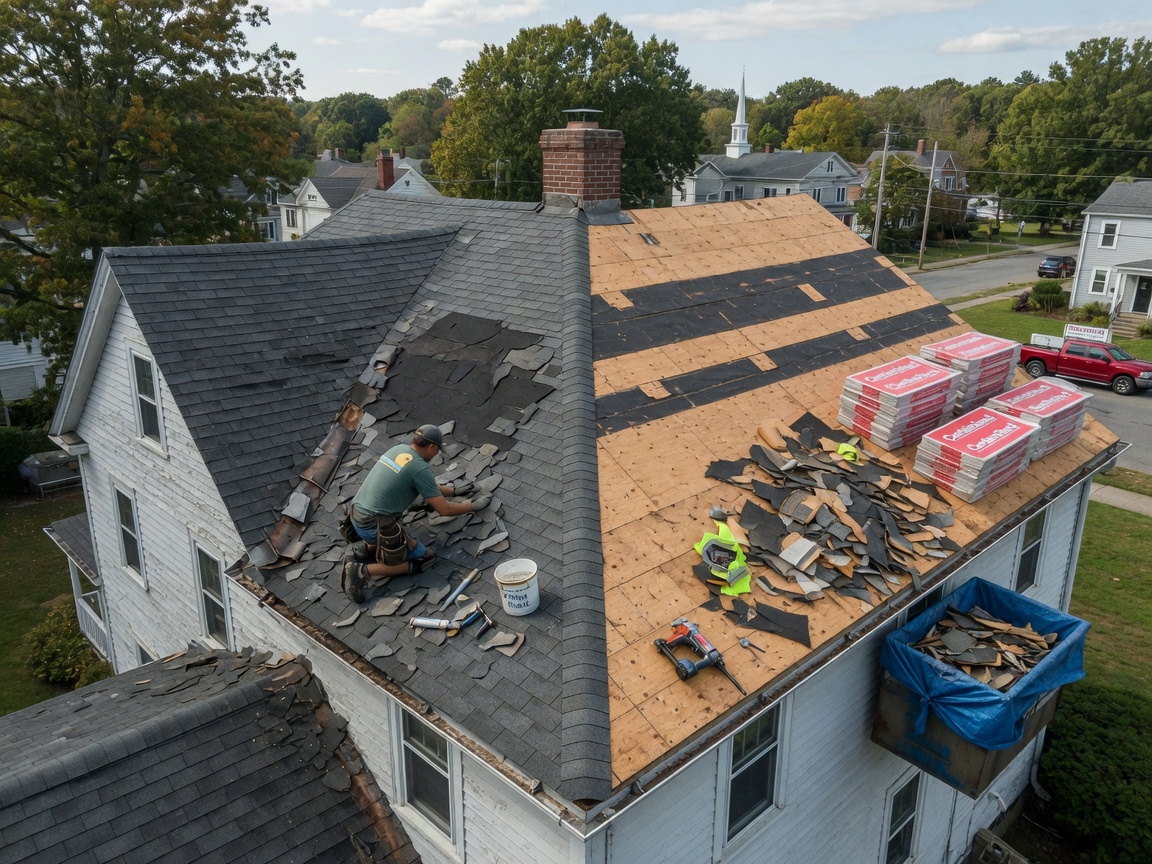
This is the question every homeowner with a leak eventually has to answer, and it is usually answered by whoever is standing in the driveway holding a clipboard. That is not a good system, because the person quoting the replacement has an obvious interest in the outcome and the homeowner has no framework for pushing back.
So here is the framework. Six questions, in order. They are the same ones we work through on an inspection, and you can answer most of them yourself.
1. How many separate failures are there?
This is the most useful single question, and it is about count and independence, not severity.
One failed detail — a split vent boot, a run of lifted step flashing, a section of wind-damaged shingles, one worn valley — is a repair. It does not matter how dramatic the water damage inside is. A cracked rubber collar the size of a saucer can soak a bathroom ceiling for two winters, and it is a couple of hundred dollars to put right.
Three or more unrelated failures on different parts of the roof is a different situation. When the chimney flashing has gone and a valley is worn through and there are nail pops across the south slope, those are not three coincidences. They are one roof reaching the end of its service life in several places at once, and repairing them individually is buying three repairs on a roof that will produce a fourth.
The practical version: if you have had two repairs in the last three years and are being asked for a third, the roof is telling you something.
2. How old is it, and what is it?
Age is context rather than a verdict. Architectural asphalt gives 25 to 30 years in this climate when properly ventilated; three-tab gives 15 to 20.
Under 15 years, a problem is almost always a defect or damage rather than wear, and the answer is a repair — possibly one somebody else should be paying for. Between 15 and 22 is the genuine grey zone where the other five questions decide it. Past 25, repairs are a holding action and should be treated as such: worth doing to get through a winter, not worth doing repeatedly.
The hidden variable is ventilation. A 19-year-old roof over a properly ventilated attic may have a decade left. The same roof over an attic with blocked soffit intake has been cooked from underneath for nineteen summers and may be finished. This is why an inspection that does not include the attic cannot really answer the question.
3. How many layers are on it?
In Massachusetts this question can settle everything on its own, and it is routinely skipped.
780 CMR caps asphalt roofs at two layers. If your house already carries two, a third is not permitted and a full tear-off is legally required. That is not a contractor's preference, it is code.
This matters for two reasons. It removes the cheap option — there is no "just go over it" — and it materially changes the price of the replacement, because tearing off two layers costs more than one in both labour and disposal. Find out before you compare quotes. A bid that quietly assumed one layer will be revised upward on tear-off morning, when you have no leverage and your house is open to the sky.
You can often count layers yourself by looking closely at a rake edge or where the roof meets a gable end.
4. Is the deck sound?
Everything above this is about the shingles. This question is about the plywood or board underneath them, and it is the one that overrides the others.
If water has been getting through for a while — and with ice dams it frequently has been, quietly, for several winters — the sheathing may have softened or delaminated. You cannot repair a roof onto a deck that will not hold a nail. Soft or spongy areas underfoot, visible sagging between rafters when you look along a slope at a low angle, or daylight and widespread dark staining visible from inside the attic all point to decking that needs replacing, and at that point the roof comes off.
This is also where quotes become dishonest. Every thirty-year-old roof in this area has some soft sheathing somewhere, usually at a north eave or around a chimney. A replacement quote with no decking allowance is not cheaper than one that has it — it has simply moved that conversation to the worst possible moment. Ask every contractor for their per-sheet rate and how many sheets they have assumed. The answer tells you whether you are looking at a complete price.
5. Is the problem the roof, or the attic?
This is the question almost nobody asks, and it is the reason a good number of homeowners in these towns have bought a roof they did not need.
If the complaint is ice dams, or staining near the outside walls upstairs, or a roof that seems to have aged unreasonably fast, the cause may not be the roof at all. Warm air escaping into a cold attic melts snow, the meltwater refreezes at the overhang, and water gets pushed back under perfectly sound shingles. Replacing those shingles changes nothing, because the new ones will sit above the same warm attic.
The diagnostic is in the attic on a cold morning: frost on the nail points, insulation packed solid into the eaves with no air gap, a bathroom fan discharging into the roof space. Correcting intake ventilation, adding baffles and air sealing the ceiling plane costs a fraction of a replacement. If somebody is quoting you a roof for an ice dam problem without having been in your attic, get a second opinion. Which failures belong to which kind of house is set out on our residential roofing page — the post-war ranches and split-levels across these towns are the ones where this comes up most.
6. What does each option cost per year of life bought?
Once you have the answers above, the arithmetic is straightforward and it is the right way to compare.
Take the repair price and divide it by the years it realistically buys. Take the replacement price and divide it by 25. Then compare.
A $900 flashing repair on a roof with twelve good years left is $75 a year. A $17,000 replacement is roughly $680 a year. The repair wins overwhelmingly and it is not a close call.
A $2,500 repair on a 26-year-old roof that will need something else next winter is perhaps $1,250 a year against that same $680. The replacement wins, and the repair is money spent on delay.
The number that should decide it is cost per year of life bought, not the headline price. This is also the honest test for whether a contractor is giving you straight advice: a roofer willing to talk you out of a replacement is worth keeping. If nobody you have spoken to has raised the possibility that your roof might not need replacing at all, you have not yet had a second opinion — you have had two sales calls.
Where this leaves you
Repair when there is one failure, the roof is under twenty, the deck is sound, and the cost-per-year arithmetic favours it. That is most situations, and targeted repair work is a large part of what we do for that reason.
Replace when there are several independent failures, or the deck has gone, or the roof is past twenty-five, or it already carries two layers. A full replacement at that point is the cheaper path over the next decade, and it is the moment to get the ventilation right at the same time — which is why we quote that as its own line rather than folding it invisibly into the total.
And get a proper inspection with an attic check and photographs before you accept any replacement quote, particularly if the inspection that produced the quote was free.
For how long you should expect the roof to last in the first place, How Long Does an Asphalt Shingle Roof Last in Massachusetts? goes through what actually determines it.