
2026-06-12 · Mark Sullivan
How Long Does an Asphalt Shingle Roof Last in Massachusetts?
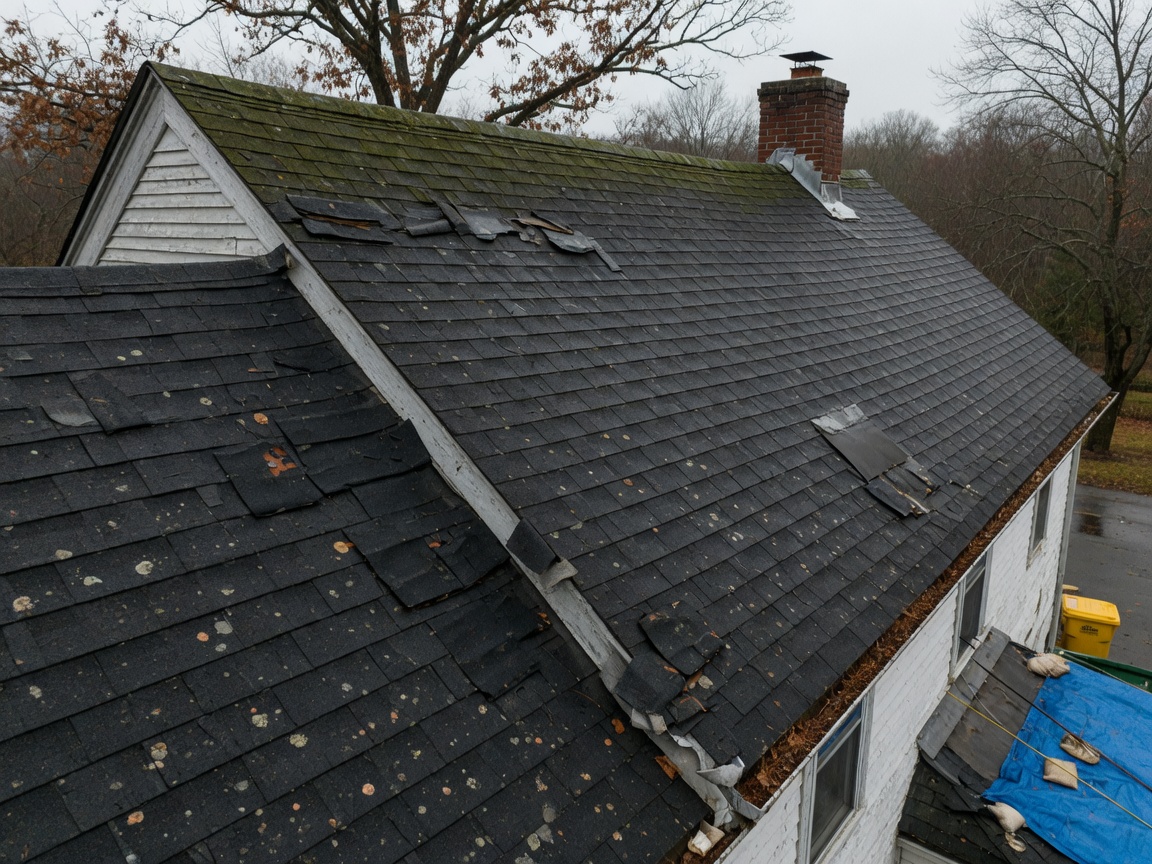
Ask five contractors how long an asphalt roof lasts in Massachusetts and you will get five numbers, all of them technically defensible. Here is the useful version: architectural asphalt shingles installed correctly on a properly ventilated attic will give you 25 to 30 years in this climate. Older three-tab shingles, which you still find on houses re-roofed before roughly 2000, give 15 to 20. But the number itself is the least interesting part of the answer, because the range between a roof that lasts 30 years and the identical roof that fails at 19 has almost nothing to do with the shingle and almost everything to do with what is underneath it.
The single biggest factor is the attic, not the roof
Asphalt shingles are damaged by heat, and most of the heat that kills them comes from below rather than above. An attic with blocked or absent soffit intake ventilation runs dramatically hotter than the outside air in summer, and the shingles sitting on that deck are being cooked from underneath for four months a year. The same attic in winter runs warm enough to melt the snow on the roof above it, which is the mechanism behind every ice dam in this part of the state.
This is not a marginal effect. On the houses we look at around Acton, Boxborough and Maynard — a great many of them ranches and split-levels built between 1955 and 1980 — the pattern is consistent enough to be predictable. The original build had modest insulation and functioning soffit vents. At some point in the eighties or nineties somebody blew cellulose into the attic to improve the heating bill, and that insulation was pushed right into the eaves, sealing off the intake. Every roof installed on that house since has been running hot, and every one of them has aged early.
It also matters commercially: nearly every shingle manufacturer's warranty is conditional on adequate ventilation. A claim on a prematurely failed roof over an unventilated attic is a claim that gets refused, and correctly so.
Slopes do not age at the same rate
Roofs are usually discussed as though they are one object with one age. They are not. On a typical house here, the south and west-facing slopes take substantially more UV exposure and degrade visibly faster — granule loss, fading, and the slight brittleness that comes before curling. The north slopes take less sun and more moisture, which means moss and algae on shaded lots, and it is where ice dam damage concentrates because the overhang stays cold longest.
The practical consequence is that it is entirely normal for one slope of a house to need attention five or more years before the rest, and it is worth knowing that before somebody tells you the whole roof is finished because one elevation looks tired. In Sudbury, Carlisle and the heavily wooded parts of Stow, we also see the opposite failure: a sound roof with one valley worn out, because pine needles packed into it have been holding water against the shingle every winter for a decade.
How to read your own roof
You can get a reasonable read on remaining life without going anywhere near a ladder.
Look in the gutters. Granules in the gutter are the shingle's protective layer leaving. A handful after a new installation is normal shedding. Consistent accumulation, enough to shovel, on a roof past fifteen means the mat is being exposed and the clock is running out.
Look along the slopes from the ground, at a low angle. What you want to see is flat and uniform. Curling at the corners, cupping in the middle of the tabs, or a general loss of the crisp shadow line between courses are all end-of-life signals — particularly when they appear across a whole slope rather than in one patch.
Go in the attic on a cold morning with a torch. This is the most informative thing available to a homeowner and almost nobody does it. Look at the underside of the roof deck and at the nail points coming through it. Frost on the nails means warm moist air is condensing up there, which tells you the ventilation is inadequate and the roof is aging early. Dark staining on the sheathing maps every leak the roof has ever had. Then look at where the roof meets the outside wall — if insulation is packed solid into that corner with no air gap, your soffit intake is blocked and that is your actual problem.
Count the layers at a rake edge. Massachusetts caps asphalt roofs at two layers, so a house already carrying two requires a full tear-off by law. It is worth knowing before you collect quotes, because a bid that quietly assumed one layer will be revised once the work starts.
Age is a prompt, not a verdict
Somewhere around year eighteen is the right moment to have a roof looked at properly rather than waiting for a leak, and that is different from replacing it. A fair proportion of the eighteen-to-twenty-five-year-old roofs we inspect need a repair and a ventilation correction, not a replacement, and telling those two situations apart is the whole value of an inspection that goes into the attic rather than one that stops at the driveway.
When the honest answer is replacement, the signals are usually unambiguous and there are several of them at once: widespread granule loss, curling across entire slopes, more than one active leak, soft decking underfoot, or a second layer already in place. One failed detail on an otherwise sound roof is a repair, and paying for a roof you did not need is a worse outcome than repairing one twice.
One caveat worth knowing if part of your roof is newer than the rest: an addition or dormer built at a shallower pitch than the main house will not last as long as the main roof whatever the shingle, because low-slope planes need a different system altogether. Those sections frequently fail first and get blamed on the shingle.
If you want the roof to reach the top of its range
Three things, in order of return on money spent.
First, fix the ventilation. Opening blocked soffit intake, installing baffles so it stays open, and running continuous ridge venting costs a fraction of a roof and is the single intervention most likely to add years. If you are replacing anyway, have it quoted as part of the job — we list it separately on every replacement quote for exactly this reason.
Second, keep the valleys and gutters clear, and do it in autumn before the first freeze. Debris left packed in a valley over winter sits wet against the shingle for four months. Under the white pine that covers much of Stow, Carlisle and Sudbury, this is the difference between a roof that wears evenly and one with a worn-through valley at year fourteen. Seasonal maintenance is dull and it is the highest-return roofing spend available.
Third, have flashing replaced rather than sealed when the roof is re-done. Reused step flashing and caulk over failing metal are the two most common reasons a nine-year-old roof is leaking, and neither is a shingle problem.
For the mechanics of how winter specifically does its damage, How Winter Weather Damages Asphalt Shingles goes through it in detail; if you are weighing a repair against a full re-roof right now, Roof Repair vs. Replacement is the more directly useful of the two.