
2026-07-24 · Mark Sullivan
How to Tell If Your Roof Leak Is Caused by an Ice Dam
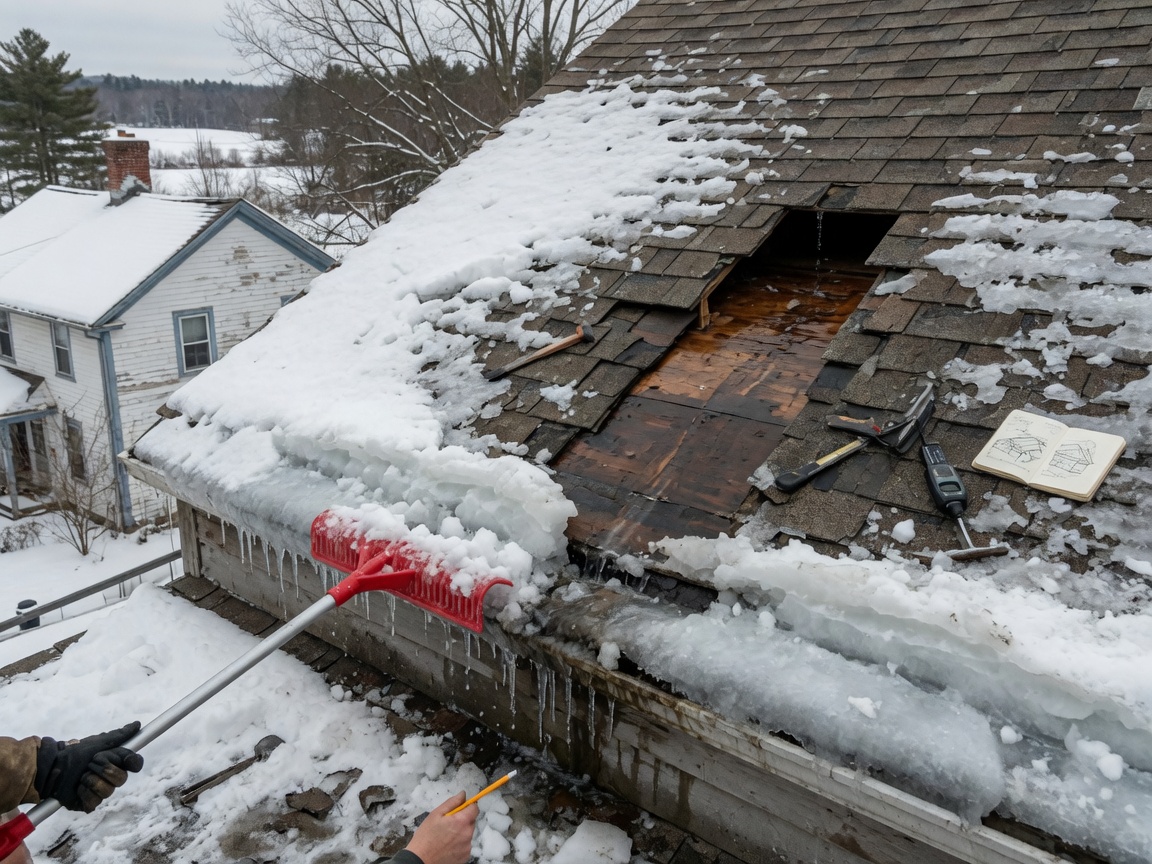
The frustrating thing about an ice dam leak is that the roof looks fine. No shingles are missing, nothing is visibly damaged, and a contractor standing in your driveway may well tell you the roof is sound — which it is. The water is getting in because it is being pushed uphill underneath intact shingles by a ridge of ice at the overhang, and that is invisible from the ground and largely invisible from the roof.
So the diagnosis happens from inside, and there are four tests. You can run all of them yourself, none of them require a ladder, and together they are conclusive.
Test one: what was the weather doing?
This single question separates ice dam leaks from almost everything else.
An ice dam leak follows a thaw, not rainfall. The sequence is: several days of cold with snow lying on the roof, then a day when temperatures rise — often only to the high thirties, sometimes with sun on the roof rather than warm air — and water appears inside within roughly 24 to 48 hours. It may appear on a completely dry, clear day. That is the signature.
A flashing or penetration leak, by contrast, tracks rainfall. It appears during or immediately after rain and does not care whether there is snow on the roof.
Condensation is the third possibility and it confuses people constantly, because it produces staining that looks identical. Condensation appears during sustained cold weather regardless of precipitation, and it tends to be diffuse — damp patches, a musty smell, moisture on the underside of the sheathing across an area — rather than a discrete drip from a point.
Write down the dates. If you have two or three events logged, the pattern usually declares itself immediately.
Test two: where in the house is it showing?
Ice dam water comes in at the eaves, so it shows up in a specific and quite narrow location: on the top floor, within about two to four feet of an exterior wall.
The classic presentations are a brown stain in the ceiling near the outside wall of an upstairs bedroom, water running down the inside of an exterior wall, staining around the head of a window on the top floor, or water appearing at the top of a stairwell where it runs against an outside wall.
What it is not is a stain in the middle of a ceiling, well away from any outside wall. Water in the centre of a room is far more likely to be coming from a plumbing vent boot, a chimney, a skylight or a bathroom fan — all of which sit up in the field of the roof.
There is one important complication: water does not always come out where it went in. It can run along the underside of the sheathing or down a rafter and emerge several feet away, which is why the attic check matters.
Test three: the attic, on a cold morning
This is the test that settles it, and it is worth doing properly.
Go up on a cold morning while there is still snow on the roof, with a torch. Do not rely on the light from the hatch.
Look at the underside of the deck near the eaves. Follow the roof line down to where it meets the outside wall. Ice dam water enters here, so this is where you find dark water staining on the sheathing, damp or matted insulation at the perimeter, and sometimes visible wet marks running down the rafters.
Look at the nail points. The nail tips coming through the sheathing are the most sensitive indicator in the building. If they are furry with frost, warm moist air is reaching the underside of your roof deck and condensing there — which means the attic is running warm, which is exactly the condition that creates ice dams. Frost on the nails is close to a positive diagnosis on its own.
Feel the sheathing with your hand. If the deck feels noticeably warmer than the outside air on a day in the teens, heat is escaping into the attic and melting the snow above.
Look at where the roof meets the outside wall. If insulation is packed solid into that corner with no air gap above it, your soffit intake ventilation is blocked. That is the most common single cause of ice dams on houses in this area, particularly the ranches and split-levels built between the 1950s and the 1980s across Acton, Boxborough, Maynard and Westford, where cellulose was blown in decades after the original build and pushed straight into the eaves.
Check where the bathroom and kitchen fans go. If a fan duct terminates in the attic instead of through the roof, it is pumping warm wet air directly into the space above your ceiling every time somebody takes a shower. It is a startlingly common fault and it accelerates everything described here.
Test four: the outside, from the ground
Some confirmation is available from the driveway, and binoculars help.
Look for a ridge of ice along the gutter line and the lower few feet of roof that persists after the rest of the roof has cleared. That is the dam. Icicles alone are not conclusive — they mean meltwater is running off, which happens on healthy roofs too — but icicles combined with a band of ice sitting on the roof surface above the gutter is the real thing.
The more telling observation is comparative: look at how the snow melts across the whole roof. A well-insulated, well-ventilated attic keeps the deck cold, and snow on that roof sits there evenly and melts slowly from the top down. If your roof shows bare patches or thin areas while the neighbour's identical roof stays covered, your attic is leaking heat. Stripes of clear roof running up the slope often mark the rafter bays where insulation has slumped or been displaced.
If the answer is yes
First, deal with the water. Move what is under it. If a ceiling is bulging with trapped water, push a small hole through the lowest point of the bulge and let it drain into a bucket — it feels like making things worse and it is the single best thing you can do, because a controlled drain usually saves a ceiling that a collapse destroys. Cut power to any circuit near the water.
Second, do not go up and attack the ice. Chipping at a dam with a hammer or hatchet removes granules, tabs and sometimes flashing along with the ice, and cold asphalt is at its most brittle. Steam is the correct removal method. What you can safely do is use a roof rake from the ground to pull snow off the lower few feet of roof, which removes the material the dam is built from.
Third, separate the repair from the cause. The repair is the damaged underlayment and sheathing at the eave, rebuilt with ice-and-water shield — that is storm and winter damage work, and if water is actively coming in it may need emergency attention first. But the cause is the warm attic, and if you fix only the roof you will be booking the same repair in two winters. Air sealing the ceiling plane, correcting insulation depth at the eaves, opening the soffit intake with baffles and running proper ridge ventilation is the work that actually ends it.
When the mechanism is unclear — and between ice dams, condensation and a genuine flashing leak it often is — an inspection that includes the attic is what tells them apart. A great many homeowners in these towns have bought a roof to solve a problem that was an insulation and ventilation job. For the underlying physics of why all this happens here, How Winter Weather Damages Asphalt Shingles covers the mechanisms; the gutter and ice dam prevention guide covers what to do before next winter.