
2026-07-03 · Mark Sullivan
How Winter Weather Damages Asphalt Shingles
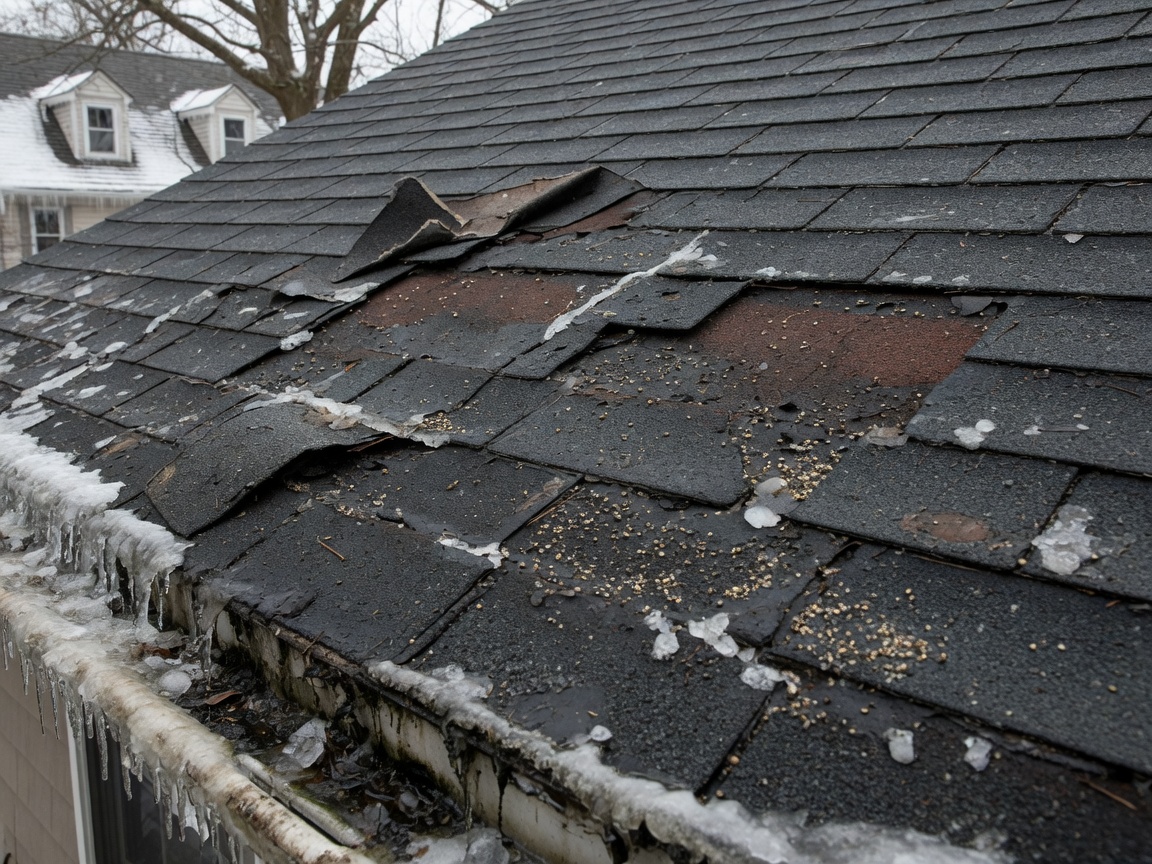
People tend to talk about winter roof damage as though it were a single thing: snow sits on the roof, the roof suffers. That is not how it works. There are four separate mechanisms at play in a Massachusetts winter, they damage different parts of the roof in different ways, and — importantly — they have different remedies. Knowing which one is happening on your house is the difference between fixing the problem and paying for the same repair every few years.
Mechanism one: thermal cycling and the freeze-thaw pump
Asphalt shingles expand and contract with temperature. In this climate that is unremarkable in summer and brutal in winter, because we do not get a steady cold — we get cycling. A February day that reaches 40°F under direct sun on a south slope and drops to 15°F overnight moves the shingle mat measurably, and it does that repeatedly, sometimes dozens of times in a season.
Two things fail as a result. The sealant strips that bond each course to the one below lose adhesion, gradually, from the edges inward. And any water already sitting in a hairline crack or under a lifted tab expands roughly nine percent as it freezes, which widens the crack every single time it happens. This is the same mechanism that destroys asphalt roads here, operating on a thinner and more fragile version of the same material.
What you see afterwards is cracking that runs across the tabs rather than along them, and a general loss of the crisp bond between courses that lets the next wind get underneath. Nothing prevents thermal cycling. What limits the damage is a roof whose sealant was properly bonded at installation — which is why cold-weather installs need hand-sealing, and why a roof laid in November without it starts its life at a disadvantage.
Mechanism two: ice dams, which are not really a roof problem at all
This is the one that causes the most expensive damage in this area, and the mechanism is worth understanding precisely because almost every proposed solution addresses the wrong part of it.
Heat escapes from the house into the attic. That warm attic heats the roof deck above it, and the snow lying on that part of the roof melts — from below, while the air outside is still well below freezing. The meltwater runs down the roof until it reaches the overhang. The overhang has no house under it, so it is at outside air temperature, and the water refreezes there. Repeat that for a few days and you have built a ridge of ice along the eave.
Now the hydraulics. The next round of meltwater arrives and cannot get past the ice, so it backs up. Shingles are designed to shed water running downhill; they are not designed to hold standing water pushing uphill underneath them. Water gets under the courses, through the nail holes, onto the deck, and into the house. Note what did not happen: no shingle was damaged, nothing blew off, and the roof looks perfect from the road. That is why homeowners stare at an intact roof and assume the leak must be coming from somewhere else.
The remedy follows from the mechanism. The dam forms because the attic is warm, so the fix is air sealing the ceiling plane, insulation depth at the eaves, and balanced intake and exhaust ventilation to keep the deck cold. Massachusetts code requires an ice barrier membrane from the eave edge to at least 24 inches inside the exterior wall line, which is genuine protection and is why a properly built modern roof leaks less — but it is a second line of defence, not a solution. Heat cables melt a channel through the dam and are sometimes the right answer on a house that cannot practically be air-sealed, but they treat the symptom and bill you for electricity every winter to do it. If you are trying to work out whether a leak you have is ice-dam related, How to Tell If Your Roof Leak Is Caused by an Ice Dam walks through the diagnostic signs, and Gutter Maintenance and Ice Dam Prevention sets out the order to spend money in.
Mechanism three: wind, which does more at low temperatures
Asphalt gets stiffer as it gets colder. A shingle at 20°F is markedly less flexible than the same shingle at 70°F, and when a nor'easter lifts it, it is more likely to crease permanently than to flex and settle back.
That creasing is the damage almost nobody finds. Wind lifts the lower edge of a shingle, tears the sealant bond, and the shingle drops back into place looking entirely undisturbed — with a horizontal crease across the mat and nothing holding it down. The slope photographs perfectly. It starts leaking a season or two later, by which time the storm date is long past and any insurance claim has become very difficult to make.
Nor'easters compound this because they arrive from the northeast, which on most houses here is the side with the least wind-rated detailing. Ridge caps and rake edges go first. On the exposed sites — the ridgelines in Bolton, the open ground in Harvard and Dunstable, the higher parts of Westford — this is the dominant winter damage mode, and the right response is to have the roof checked specifically for broken seal bonds within a few weeks of a significant storm rather than waiting for water. Storm and winter damage assessment is worth doing while the damage is still attributable.
Mechanism four: the damage done by removing the snow
A meaningful share of the winter repairs we carry out were caused by somebody trying to prevent winter damage.
Attacking an ice dam with a hammer, chisel, hatchet or crowbar removes the ice and takes shingle granules, shingle tabs and sometimes flashing with it. Chopping at ice that is bonded to a roof surface at 20°F, when the asphalt underneath is at its most brittle, is close to the worst possible combination of conditions. Steam is the correct method for removing a dam, because it releases the ice without touching the shingle.
Walking on a snow-covered or frost-covered roof does its own damage, aside from the obvious risk to the person doing it: you cannot see what you are standing on, and cold shingles crack under point loads that would be harmless in July.
The thing a homeowner can safely and usefully do is use a roof rake from the ground to pull snow off the lower few feet of roof before a dam forms. That removes the material the dam would be built from, it requires nobody to leave the ground, and it is genuinely effective. It is also worth knowing that a structurally sound roof in this area is designed against our ground snow load and is very unlikely to fail under snow weight — what warrants attention is drift accumulation in valleys, behind dormers and on lower roofs below a taller wall, where depth can be several times that of the open field.
What this means in practice
The four mechanisms point to different work, and it is worth being clear about which one your house actually suffers from before spending money.
If water appears at the eaves or in second-floor ceilings a day or two after a thaw, that is ice dam hydraulics and the answer is in the attic. If shingles are cracking across the tabs and the courses have lost their bond, that is thermal cycling and the roof is simply aging. If damage appeared after a specific storm, that is wind, and it should be documented and inspected quickly. And if the damage is concentrated exactly where somebody was chipping at ice last February, that is mechanical, and it is a repair.
The preventive work that pays for itself is unglamorous: get the attic ventilation right, clear valleys and gutters in autumn before the first freeze, and have flashing replaced in metal rather than sealed with caulk when the roof is re-done. Seasonal maintenance covers the first two; the seasonal checklist sets out what to do when.