
2026-09-18 · Mark Sullivan
Gutter Maintenance and Ice Dam Prevention: A Homeowner's Guide
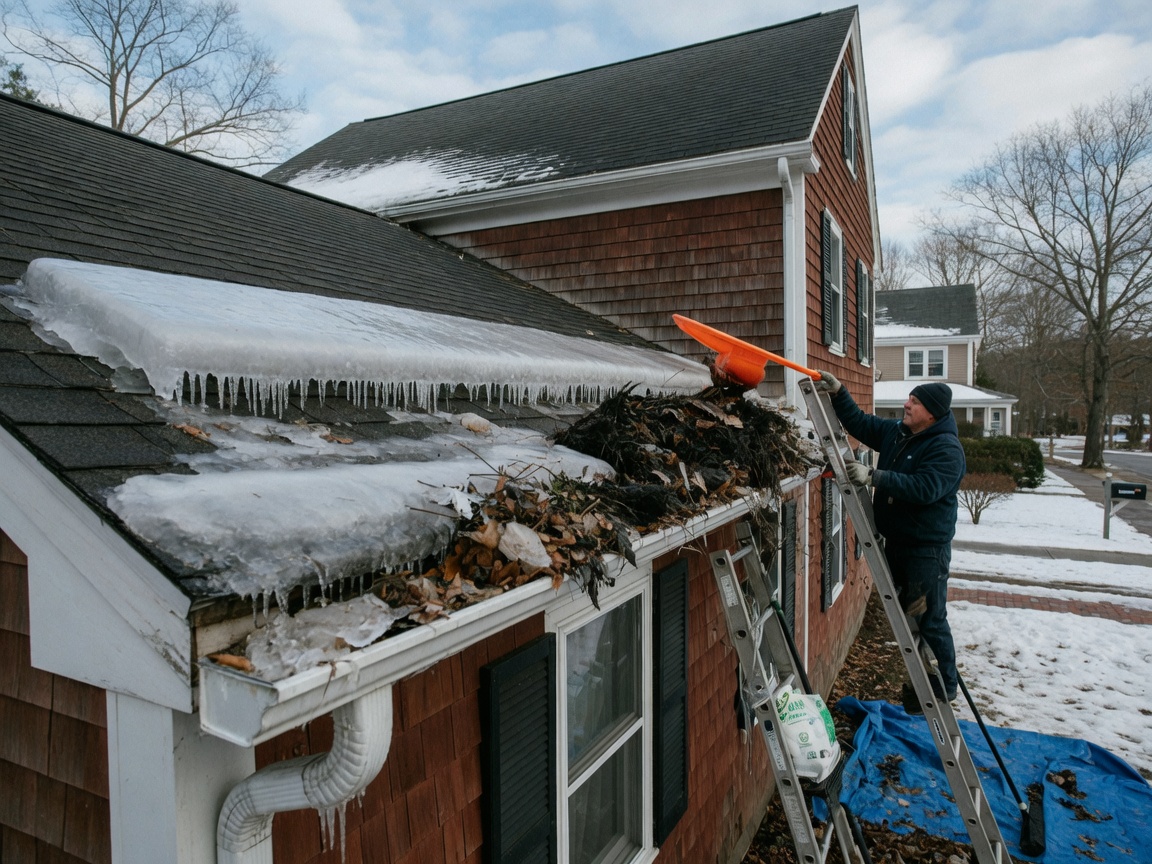
There is a persistent belief in New England that gutters cause ice dams, and a matching belief that removing them solves the problem. Both are wrong, and the confusion costs people money — either on gutter work that does not fix the leak, or on tearing off gutters that were doing a useful job.
The short version of the cause: heat escaping into a cold attic melts snow on the upper roof, that meltwater refreezes at the cold overhang where there is no heated house beneath it, and the resulting ice backs the next round of water up under the shingle courses. How Winter Weather Damages Asphalt Shingles sets out the hydraulics properly, alongside the three other ways winter damages a roof here.
What matters for this article is the thing that description leaves out entirely: the gutter plays no part in forming the dam. A house with no gutters at all will still form ice dams if the attic is warm, and plenty do. This is why ice dams are an insulation and ventilation problem wearing a roofing costume — and why a gutter contractor cannot solve one.
What gutters genuinely do contribute
Having said that, gutters are not irrelevant — they make the consequences worse in three specific ways, and all three are worth fixing.
A blocked gutter holds standing water and ice at the coldest point of the roof. It does not start the dam, but it gives it a foundation and adds to the mass of ice sitting against your shingle courses and fascia.
An undersized gutter overflows during thaws, so meltwater that should be leaving the property runs behind the fascia board instead, rotting it and soaking the soffit. A great many rotted fascias in this area are gutter overflow, not roof leaks.
Ice in a gutter is extraordinarily heavy, and the hanger spacing that is perfectly adequate for rain is what tears loose in January — taking fascia with it. This is the most common gutter failure we repair around Boxborough, Acton and Westford, and it is a fixing problem rather than a gutter problem.
So: clearing and correctly sizing your gutters will not prevent ice dams. It will meaningfully reduce what they damage.
Sizing is a calculation, not a default
Almost every house in this area has five-inch K-style gutters with two-by-three downspouts, because that is the default. It is adequate for a modest single-storey roof and inadequate for a lot of what it has been fitted to.
Six-inch gutters with three-by-four downspouts carry substantially more water and cost marginally more. They are worth it on larger roof areas, on steep pitches that deliver water fast, and on any run collecting from a valley.
That last point is the one that fixes the most persistent complaints. If your gutter overflows at the same spot every time it rains hard, and you have cleaned it, the problem is almost certainly that a valley is dumping the concentrated flow of two roof planes into a single point of a run with no outlet beneath it. No amount of cleaning will change that. Adding a downspout directly under the valley will. It is probably the most common gutter misdiagnosis in these towns — we have seen homeowners clean the same corner four times a year for a decade.
The other sizing item is discharge. Water leaving a downspout at the foundation is one of the more common causes of a wet basement here, particularly on lots where the grade runs back towards the house. Extensions taking discharge several feet out, or a buried line to a suitable outfall, solve problems people otherwise spend far more money on from the inside. On the many properties around here on private septic systems, where the water goes matters for a second reason: a concentrated discharge point over a leaching field adds load the system was never sized for.
Guards: it depends entirely on your trees
This is the question we get asked most, and the honest answer is that most guard systems sold in this area are the wrong ones for our trees.
Under oak and deciduous cover, a decent guard works well. Leaves are large, they sit on top, and a good screen or micro-mesh keeps them out. It pays for itself in cleanings avoided.
Under white pine — which is a great deal of Stow, Carlisle, Sudbury, Concord and the wooded parts of Acton — most guards make things worse. Pine needles are small enough to pass through standard screen, and on anything with a coarse aperture they mat into a felt on top that blocks the gutter completely while being far harder to clear than loose debris. Foam and brush inserts are the worst option available under conifers: they turn a clearable gutter into a sealed tube packed with slowly composting needles, and cleaning them properly means pulling the entire insert out.
Fine stainless micro-mesh is the only type that handles needles properly. It costs more than the hardware-store options and it is the cheaper choice over ten years.
No guard system means never cleaning the gutter again. They extend the interval considerably; they do not eliminate it.
The order of fixes that actually works
If you are getting ice dams, spend money in this order. It is roughly the reverse of what most people do.
First, air seal the ceiling plane. Recessed lights, the attic hatch, plumbing and wiring penetrations, the top plates of interior walls. This is where warm air gets into the attic in the first place, and it is the cheapest item on this list.
Second, fix the intake ventilation. On the ranches and split-levels built across these towns between the 1950s and 1980s, blown-in insulation added decades after the original build is almost always packed into the eaves, sealing off the soffit vents. Opening that intake and installing baffles so it stays open is inexpensive and it is frequently the whole answer.
Third, get the insulation depth right at the eaves, without re-blocking the intake you just opened.
Fourth, ensure balanced exhaust — continuous ridge venting, and check that any bathroom or kitchen fan actually discharges through the roof rather than into the attic. A fan dumping warm wet air under the sheathing is startlingly common and undoes everything above it.
Fifth, then deal with the gutters. Clear them, size them properly, add outlets where valleys concentrate flow, and re-hang on closer spacing so the ice load does not pull them off.
Heat cables come last, if at all. They melt a channel through the dam and they are sometimes the right answer on a house that genuinely cannot be air-sealed — a cathedral ceiling with no accessible attic, for instance. But they treat the symptom, they run on your electricity every winter, and they fail. Fitting heat cables to a house with blocked soffit vents is paying an annual fee to avoid a one-off repair.
The autumn deadline
One piece of timing worth knowing: the gutter clearing that matters is the one done in late autumn, before the first hard freeze. A gutter that goes into winter blocked holds ice all season, and by the time you notice, the damage is done and it is too cold to work on safely.
The same applies to the roofing side. Sealant will not bond below about 50°F, so flashing and ridge cap work has a real deadline in this climate. October is worth considerably more than April for preventive work — which is the logic behind the seasonal maintenance schedule and the full seasonal checklist.
If your gutters are already pulling away, overflowing at a fixed point or rotting the fascia behind them, that is gutter repair and re-hanging work rather than a cleaning problem. If water is already getting into the house after thaws, How to Tell If Your Roof Leak Is Caused by an Ice Dam will help you confirm the mechanism, and the eave rebuild plus ventilation correction is winter damage work. Whatever else you do, fix the cause as well as the damage — otherwise the same repair comes round again in two winters.