
2026-09-04 · Mark Sullivan
Roof Maintenance Checklist: What New England Homeowners Should Do Every Season
Most roof maintenance checklists are padded. They list twenty items because twenty looks thorough, and they give equal weight to things that matter enormously and things that do not matter at all. This one is organised by season, marks what is genuinely worth doing, and says plainly which jobs a homeowner should not attempt.
The headline, if you read nothing else: autumn is the season that counts. Everything on the autumn list changes what happens in February. Everything on the spring list is assessment after the fact. If you can only manage one round of maintenance a year, do it in October.
Autumn — the one that matters
Do this between late September and early November. The sealant work in particular has a hard deadline, because roofing sealant will not bond properly below about 50°F, so once November has gone you have lost the window until spring.
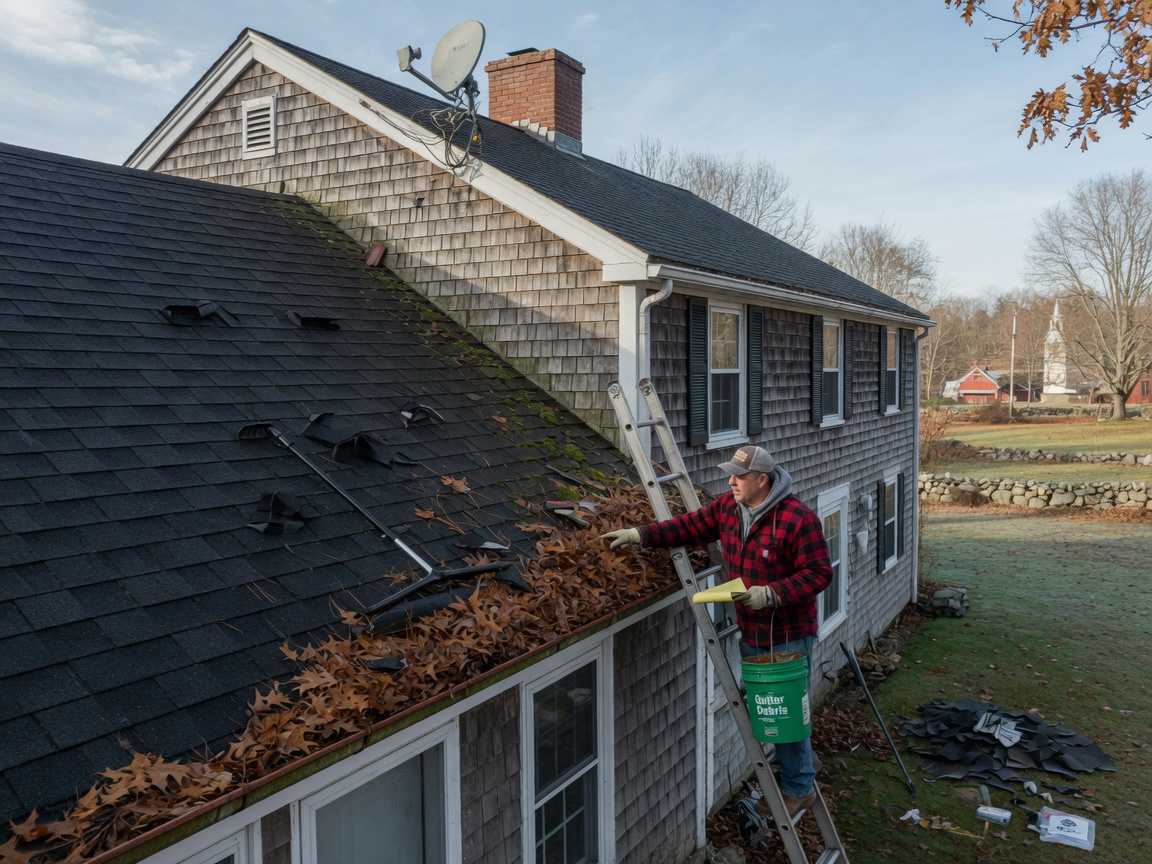
Clear the gutters and downspouts. Not optional. A gutter that goes into winter blocked holds standing ice at the coldest point of the roof all season, and overflow runs behind the fascia rather than away from the house. Check that water actually exits the downspout, and that the discharge goes several feet from the foundation rather than straight into it.
Clear the valleys, behind the chimney, and any dormer junctions. This is the single highest-value maintenance item in this area and it is the one homeowners skip. Debris packed into a valley holds water against the shingle continuously for four months. Under the white pine that covers much of Stow, Carlisle, Sudbury and Concord, this is what wears a valley through at year fourteen on a roof that should have run thirty.
Renew the sealant at flashings, ridge caps, vents and penetrations — professional item, and the reason the autumn visit has a deadline.
Refasten anything lifting. Loose ridge caps and lifted shingle edges are what the first nor'easter finds.
Check the attic before it gets cold. Look at the insulation where the roof meets the outside wall. If it is packed solid with no air gap above it, your soffit intake is blocked and you will get ice dams. Correcting that in October is the difference between a normal winter and a wet ceiling.
Cut back overhanging limbs. They abrade the roof in every wind and drop the debris you have just cleared.
Winter — mostly leave it alone
The winter list is short and half of it is about what not to do.
Rake snow off the lower few feet of roof from the ground after significant snowfall, using a proper roof rake. This removes the material an ice dam would be built from and requires nobody to leave the ground. It is the one genuinely useful winter action.
Watch the drift areas — valleys, behind dormers, and lower roofs sitting below a taller wall. Snow accumulates several times deeper there than on the open field. A structurally sound roof in this area is designed against our ground snow load and is very unlikely to fail under snow weight, but drift areas are the exception worth attention.
Check the attic once mid-winter on a cold morning. Frost on the nail points means warm moist air is condensing under your deck. Damp insulation at the eaves means water is already getting in.
Watch for stains on upstairs ceilings near outside walls in the day or two after a thaw. That timing is the signature of an ice dam leak.
Do not get on a snow-covered or frozen roof. Do not attack an ice dam with a hammer, chisel or hatchet — it removes granules, tabs and flashing along with the ice, and cold asphalt is at its most brittle. Steam is the correct method and it is a professional job.
Spring — assess the damage
March through May, once the snow has gone. This is the audit of what winter did.
Look for wind damage properly. Missing shingles are the obvious part and usually the smaller part. The damage that matters is shingles still in place that have lost their seal bond — they lift with no resistance and carry a horizontal crease across the tab. That slope looks perfect and starts leaking the following winter, long after any insurance claim has become difficult. On the exposed sites in Bolton, Harvard, Dunstable and the higher parts of Westford, this is the most common winter damage there is.
Check the eaves for ice dam aftermath — lifted shingle courses, staining on the fascia, damaged gutter hangers.
Look in the gutters for granules. Consistent accumulation on a roof past fifteen means the mat is being exposed.
Check the attic again for new staining on the sheathing that was not there in autumn. It is the earliest possible warning of a leak, well before anything reaches a ceiling.
Clear the gutters again — winter debris plus early tree drop.
If the spring audit finds something, this is the right time to act on it. Spring and early summer book out fastest precisely because everyone discovers their winter damage at once.
Summer — the quiet season
Least urgent, and a good time for planned work rather than reactive work.
Look at the south and west slopes. These take the most UV and age fastest, so this is where you will see curling, cupping and fading first. It is entirely normal for one slope to need attention years before the rest.
Treat moss and algae on shaded north slopes — chemically, then let it weather off. Never pressure wash a roof. It strips the granules that give the shingle its service life, in exchange for looking better for one season.
Check the vent boots. The rubber collars around plumbing stacks harden and split, typically between years twelve and eighteen, and a hairline crack will soak a ceiling. This is one of the cheapest repairs there is and one of the most commonly misdiagnosed as needing a whole roof.
Schedule planned work now. If the spring audit said the roof has two or three years left, booking in late summer or autumn gets you better scheduling than the spring rush. This is also the right season for anything involving new structure — an addition, a dormer, a garage — because new roof installation has to fit a builder's programme rather than a weather window.
How often, and what it is worth
Twice a year — autumn and spring — on any roof past about ten, and on any roof under heavy tree canopy at any age. Once a year, in autumn, is the realistic minimum worth doing. A roof under ten years old with clear exposure can go two or three years between visits without much risk.
What maintenance genuinely buys you is several years on an asphalt roof, and it buys them at the details rather than in the field. Flashings, penetrations and valleys are where roofs fail early, and those are exactly what maintenance addresses. What it will not do is extend the life of shingles that have reached the end of their service life, and anyone selling you a maintenance plan on a twenty-eight-year-old roof is selling you a delay.
There is also a paperwork argument that homeowners tend to discover too late. Shingle manufacturer warranties are conditional on adequate ventilation and reasonable upkeep, and refused claims commonly cite one or the other. A dated, photographed record of what was checked and done is the evidence that removes that argument — and it is a genuinely useful document when you come to sell the house. On commercial low-slope roofs this is not merely useful but usually contractual: most membrane warranties require documented periodic inspection, and losing the records is how a valid warranty quietly becomes an invalid one.
What to leave to someone else
Clearing gutters from a ladder is a normal homeowner job. Raking snow from the ground is a normal homeowner job. Everything that involves being on the roof is not, and that is not sales talk — walking a roof damages shingles if you do not know where to put your feet, and the fall risk is the reason roofing insurance costs what it does.
The items worth having a professional do are the ones with consequences: sealant renewal while it can still bond, flashing replacement in metal rather than caulk, steam removal of ice dams, and ventilation correction. Those make up most of a maintenance visit, and they are the ones that actually add years.
If the spring audit turns something up, repair work on a single detail is usually far smaller than people fear. If you are not sure whether what you are looking at is normal aging or a real problem, an inspection with the attic included and photographs settles it. And for the winter half of the calendar, Gutter Maintenance and Ice Dam Prevention goes deeper on the autumn work that prevents the February problem.